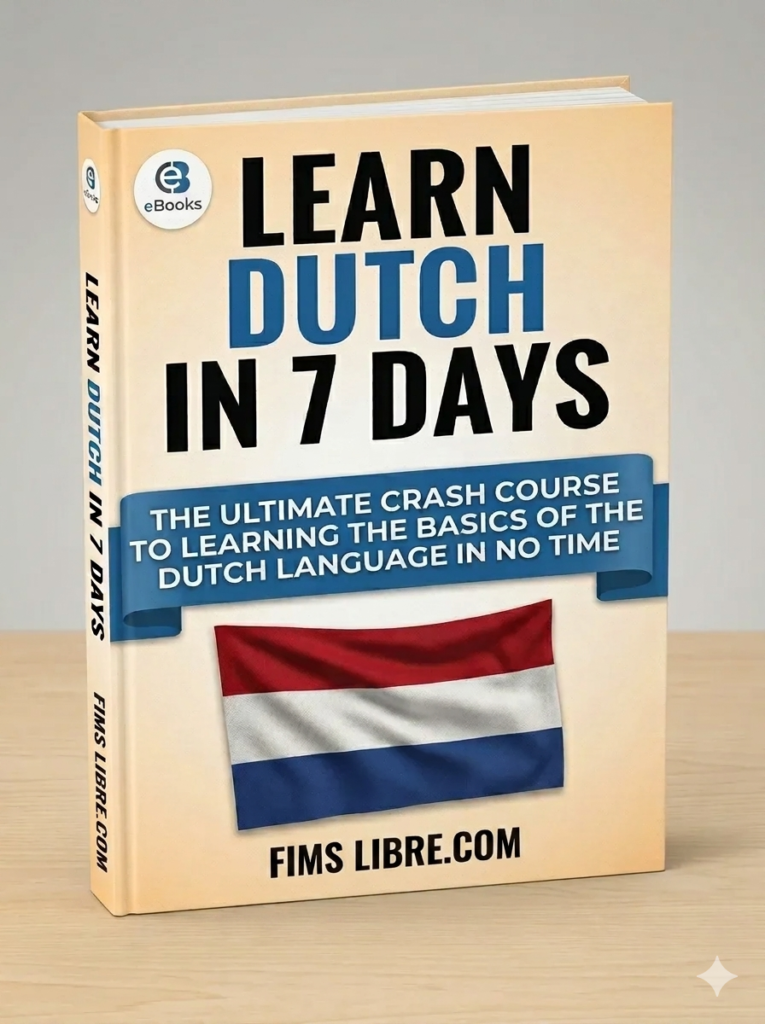
Review: Learn Dutch in 7 Days
So, I decided to pick up this book, Learn Dutch in 7 Days, and yeah, the title is a bit bold, isn’t it? Seven days is a pretty short time to learn a language as notoriously tricky as Dutch. But I was curious. It’s one of those books that promises you the world in a tiny package. I went into it thinking it’d be just another basic guide, but honestly, it ended up being a bit more of an interesting experiment than I anticipated. It’s definitely one of those books that you pick up because you want a quick fix, and while it doesn’t quite perform magic, it’s not entirely without its charm.
📖 About This Book
It’s definitely not a deep, academic dive into linguistics. If you’re looking for a thick, dusty tome filled with complex grammar rules, this isn’t it. It’s very much a “get-in-get-out” kind of book. The vibe is purely practical. It feels like the author sat down and tried to strip away all the fluff, leaving you with just the bare-bones essentials you need to start making sense of Dutch sounds. It’s light, it’s fast, and it doesn’t try to be anything it isn’t. You can literally carry it around in your bag and flip through a couple of pages while waiting for the bus, which is honestly how I ended up consuming most of it.
🧠 Book Summary
The whole point here is to give you a “crash course.” It doesn’t expect you to be fluent by the end of the week, obviously—that would be insane—but it tries to build a foundation. You’re looking at basic vocabulary, some sentence structures, and a few phrases that’ll keep you from getting lost if you ever find yourself wandering around Amsterdam. It’s really about building that initial momentum. For a lot of people, the hardest part of a new language is just starting, and this book tries to lower that barrier of entry significantly. It’s not trying to teach you everything; it’s trying to teach you enough to function.
⭐ Key Highlights
- Speed is the focus: Every chapter feels like it’s designed to be knocked out in an hour or two. You aren’t getting bogged down in endless theory.
- Practical phrases: It skips the weird “the cat is on the table” stuff and gets straight to things you might actually say to a real person.
- Simplified structure: I liked how it doesn’t overcomplicate the grammar, which is usually the part that makes people run for the hills. It makes the language feel approachable.
🎯 What You Will Learn
You’re not going to be having long, philosophical conversations, but you will definitely feel less intimidated by the language. You’ll pick up how to introduce yourself, how to ask for directions, and you’ll start to get a feel for the rhythm of the language. Honestly, the biggest thing I learned was just how similar it is to English in some ways, which was a nice surprise. It takes the “scary” factor out of Dutch. You start to see that you can actually understand bits and pieces even when you aren’t trying that hard. It gives you just enough to feel like you’re actually getting somewhere.
👥 Who This Book Is For
If you’re moving to the Netherlands next week and you know absolutely nothing, this is a great starting point to at least know how to say “hello” and “where is the bathroom.” It’s for the busy person who doesn’t have time for a three-month course but wants to dip their toes in. If you’re a complete beginner who just wants to get a feel for the language, you’ll find it helpful. But look, if you’re trying to reach C1 fluency, this is obviously just a tiny stepping stone.
💡 My Honest Opinion
Look, I have to be fair here. Is the “7 days” claim a bit of a marketing stretch? Yeah, totally. You’re not going to be a native speaker in a week. If you expect that, you’ll be let down. I felt a little skeptical at first because it feels like a big promise, but once I lowered my expectations and treated it as a “beginner’s introduction,” I actually started to enjoy it.
It’s a bit informal, which I liked, but there were moments where I wished it explained why certain phrases work the way they do. Sometimes it just tells you “this is how you say it,” and I’m the type of person who needs to know the logic behind it. But then again, if it did that, the book would be three times as long, so maybe the brevity is the point. It’s a bit of a trade-off. I felt like it really helped me gain some confidence, which is honestly the most important part of language learning anyway. It’s not a masterpiece, but it’s a handy little resource to have in your bag.
📥 Final Note
If you’re just looking for a way to get started without feeling overwhelmed, give it a shot. Don’t stress about the “7 days” deadline. Just take your time, go through the pages, and see how much you can pick up. It’s a low-pressure way to start something new, and honestly, we could all use a little more of that in our lives. Don’t overthink it—just start reading and see where it takes you. Happy learning!
📚 Related Books


Join Our Facebook Learning Groups
🇩🇪 Learn German Free 🇬🇧 English Learning Group 🇪🇸 Spanish Learning GroupJoin our educational Facebook communities to improve your language skills, practice daily conversations, and connect with learners from around the world.