Surviving Sunday Night Lesson Planning: My Take on “100 Ideas for Secondary Teachers: Outstanding Lessons”
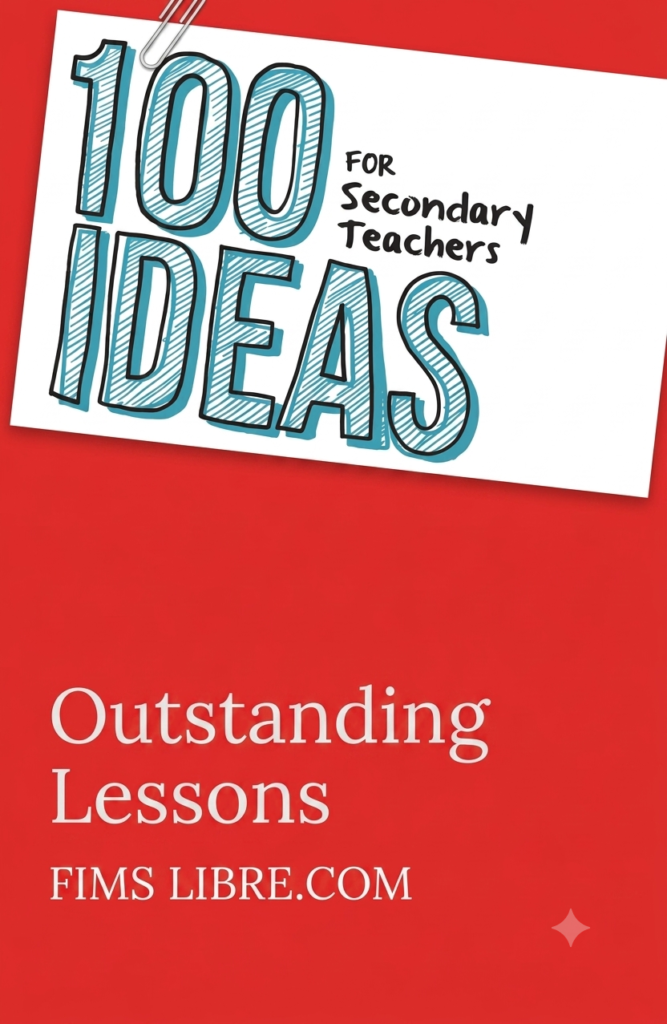
Every teacher knows that specific, creeping dread that hits around 4 PM on a Sunday afternoon. You’re sitting on the couch, staring at a blank lesson plan template, trying to figure out how to make a dry topic somehow look “outstanding” for an upcoming observation. I picked up this bright red book with the hand-drawn, sketchy “100 IDEAS” text on a slanted white index card graphic on the cover. It calls itself 100 Ideas for Secondary Teachers: Outstanding Lessons. Honestly, whenever a book promises a flat, even triple-digit number of “perfect” solutions, my cynical radar starts buzzing. But I spent the last week marking up pages to see if these suggestions are actually usable in a chaotic high school classroom, or if they are just theoretical nonsense written for a perfect school environment that doesn’t actually exist.
To be fair, teaching books usually fall into two categories: painfully dense academic research papers that offer no quick strategies, or overly simplified activity lists that feel like they were made for primary school kids. This one tries to sit right in the middle, focusing explicitly on the secondary level where the students are older, more easily bored, and infinitely harder to impress. Let’s look down under the flashy cover to see if it delivers real value.
What is this book actually trying to solve?
The book isn’t a long narrative you read from chapter one to chapter ten. It is basically a curated toolbox of independent, bite-sized strategies designed to shake up your routine teaching methods. The core objective here is engagement—taking standard, curriculum-heavy topics and wrapping them in clever structural frameworks that force teenagers to actively think rather than just stare blankly at a whiteboard.
I feel like the layout understands that teachers have zero spare time. Each idea is intentionally restricted to a quick, highly digestible format. It gives you a quick overview, a step-by-step implementation guide, and a small tip for stretching the idea further or scaling it down for struggling students. It’s built for rapid consumption when you are desperate for an idea five minutes before your morning registration period.
The Strategies That Stand Out
The book categorizes its 100 entries into loose thematic chunks, moving from initial starters to deep collaborative activities. Here is a rough look at what you run into across the pages:
• Hook Starters: Fast, five-minute introductory challenges designed to grab attention the second students drop their bags at the desks.
• High-Stakes Group Work Layouts: Frameworks that avoid the classic pitfall where one student does all the work while the other three check their phones.
• Metacognitive Plenaries: Quick review activities that don’t just ask “what did we learn today?” but actually push students to analyze how their thinking shifted over the hour.
• The “Bonus Tip” System: Small, isolated callout blocks on almost every page that suggest variations for different subject disciplines, from history to science labs.
What do you actually gain as an educator?
Working through these entries expands your personal pedagogical reflexes. You start looking at an everyday vocabulary list or a history timeline and immediately think of three different ways to turn it into a dynamic, student-led sorting game. It breaks your internal habit of relying on the standard “read the chapter and answer the textbook questions” fallback loop that we all drift into when we are completely exhausted.
Who is this meant for?
This volume is specifically customized for secondary school teachers—meaning middle and high school environments. It is a godsend for Early Career Teachers (ECTs) who are still building up their basic routine repertoire. But honestly, it’s also incredibly useful for veteran teachers who have been using the exact same lesson plans for the last seven years and need a sharp, low-prep spark to make their teaching feel fresh again.
My Honest Opinion: The Triumphs and the Limits
Let’s talk real talk. What I love about this book is how deeply pragmatic it is. It skips the massive, boring educational philosophies and jumps straight into the action. A good chunk of these ideas require absolutely zero printing, photocopying, or expensive resources, which is fantastic because nobody has the budget or time for that anymore. I tried one of the quick starter sorting ideas with my class last week, and it completely changed the energy level of the room within minutes.
However, let’s be real: not all 100 ideas are masterpieces. Some entries feel like filler text—basic variations of standard classroom strategies that you probably learned during your first month of teacher training. If you’ve been teaching for a decade, about forty percent of this book will make you say, “Well yeah, obviously I already do that.”
I don’t know why but I also find the title a bit misleading. Calling a lesson “outstanding” implies that the book will give you a magic spell to pass a formal inspection effortlessly. The truth is, these are just great, isolated *components*. You still have to do the heavy lifting of stitching them naturally into your specific curriculum goals so it doesn’t just look like a random game day.
📚 Related Books

Join Our Facebook Learning Groups
🇩🇪 Learn German Free 🇬🇧 English Learning Group 🇪🇸 Spanish Learning GroupJoin our educational Facebook communities to improve your language skills, practice daily conversations, and connect with learners from around the world.