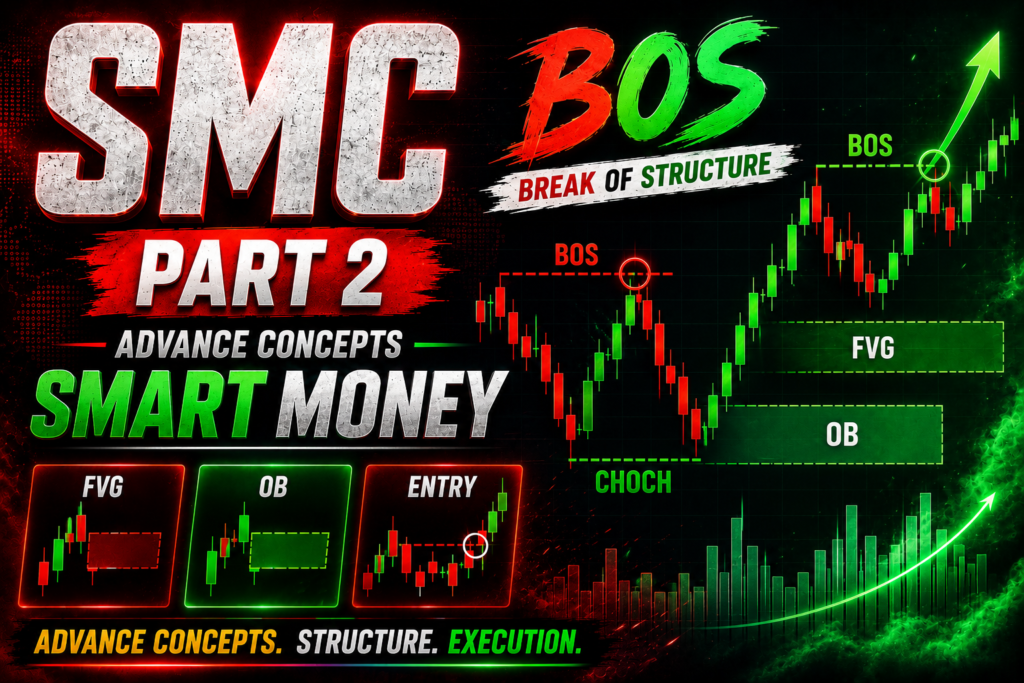
🚀 Part 2: Advanced Smart Money Concepts (SMC) – Structure & Execution
Welcome to Part 2 of our Smart Money Concepts (SMC) series! 📈 In Part 1, we covered the foundations of SMC, including Market Structure, Break of Structure (BOS), Fair Value Gap (FVG), Order Blocks (OB), and basic trade execution.
Now it’s time to move deeper into the world of institutional trading 🏦. In this part, we will focus on Advanced Market Structure and Professional Trade Execution techniques used by experienced SMC traders.
📊 Understanding Advanced Market Structure
Most beginner traders only focus on whether the market is bullish 📈 or bearish 📉. However, professional traders go beyond that and analyze how price is creating structure on multiple timeframes.
Advanced Market Structure involves understanding internal and external structure. External structure refers to major swing highs and swing lows, while internal structure focuses on smaller movements occurring inside the larger trend.
🎯 Institutions often use internal structure to create liquidity and trap retail traders before continuing toward the external trend direction.
🔄 Internal vs External Structure
External Structure represents the bigger picture of the market. This is where major highs and lows are formed.
Internal Structure consists of smaller BOS movements and temporary trend shifts that happen within the larger trend.
- 📈 External Structure = Major market direction
- 📊 Internal Structure = Short-term movements
- 🎯 Smart traders align both structures before entering trades
When internal structure aligns with external structure, the probability of a successful trade often increases significantly.
⚡ Liquidity and Market Manipulation
Liquidity is one of the most important concepts in advanced SMC trading. Liquidity refers to areas where stop losses and pending orders are concentrated.
🏦 Large institutions require liquidity to enter and exit positions. Because of this, price often moves toward areas where liquidity exists before reversing.
This is why traders frequently see stop hunts, fake breakouts, and sudden price spikes. These movements are often designed to collect liquidity before the real move begins.
💡 Instead of chasing these moves, advanced traders wait for confirmation after liquidity has been taken.
🎯 Liquidity Sweep
A Liquidity Sweep occurs when price temporarily moves above a high or below a low to trigger stop losses and pending orders.
After collecting liquidity, price often reverses and moves in the intended direction.
- 📈 Buy-side Liquidity = Above previous highs
- 📉 Sell-side Liquidity = Below previous lows
- ⚡ Liquidity Sweep = Temporary grab of liquidity
Liquidity Sweeps are commonly used as confirmation before entering trades because they reveal where institutions may be active.
🔥 Advanced BOS Confirmation
While beginners enter immediately after a BOS, professional traders look for stronger confirmation.
A quality BOS should:
- ✅ Break a significant structure level
- ✅ Show strong momentum
- ✅ Remove liquidity first
- ✅ Align with higher timeframe direction
A weak BOS without liquidity removal may lead to false signals and lower-probability trades.
🧱 Advanced Order Block Usage
Not every Order Block is worth trading. Advanced SMC traders carefully filter Order Blocks based on market context.
A strong Order Block typically:
- 🏦 Causes a major market move
- ⚡ Creates a clear BOS
- 📊 Aligns with higher timeframe structure
- 💧 Appears after liquidity has been taken
The more confirmations an Order Block has, the stronger its potential reaction can be.
⚡ Fair Value Gap Refinement
Advanced traders do not treat every Fair Value Gap equally. Instead, they focus on high-quality imbalances created during strong institutional moves.
When an FVG forms after a liquidity sweep and BOS, it often becomes a high-probability retracement zone.
🎯 Many professional traders combine FVGs with Order Blocks to improve entry precision and reduce risk.
🎯 Professional Trade Execution
Execution is where many traders struggle. Understanding concepts is important, but applying them correctly is what separates profitable traders from losing traders.
A professional execution model often follows these steps:
- 📊 Identify higher timeframe bias
- 💧 Mark liquidity zones
- ⚡ Wait for liquidity sweep
- 🚀 Confirm BOS
- 🧱 Locate Order Block or FVG
- 🎯 Enter on retracement
- 🛡️ Place stop loss logically
- 💰 Target key liquidity levels
This approach helps traders avoid emotional entries and focus on structured decision-making.
🧠 Risk Management Matters
Even the best SMC setup can fail. This is why risk management remains essential.
- 🛡️ Risk only a small percentage per trade
- 📊 Maintain a positive risk-to-reward ratio
- ❌ Never move stop losses emotionally
- ✅ Follow your trading plan consistently
Professional traders focus more on protecting capital than on chasing profits.
🌟 Key Takeaways
- 📈 Analyze both internal and external structure
- 💧 Understand liquidity behavior
- ⚡ Wait for liquidity sweeps
- 🚀 Confirm with strong BOS
- 🧱 Use high-quality Order Blocks
- 📊 Refine entries with FVGs
- 🎯 Execute trades systematically
- 🛡️ Prioritize risk management
🏁 Conclusion
Advanced Smart Money Concepts take trading beyond basic structure analysis and introduce a deeper understanding of liquidity, manipulation, institutional behavior, and professional execution.
📚 By mastering Internal Structure, Liquidity Sweeps, Advanced BOS confirmation, refined Order Blocks, and proper execution models, traders can develop a more complete understanding of how markets truly operate.
🚀 In Part 3, we will explore even deeper institutional concepts and advanced trade models that can help improve precision, timing, and overall trading performance.
📚 Related Books
Join Our Facebook Learning Groups
🇩🇪 Learn German Free 🇬🇧 English Learning Group 🇪🇸 Spanish Learning GroupJoin our educational Facebook communities to improve your language skills, practice daily conversations, and connect with learners from around the world.